Search is no longer just about ranking on page one—it’s about being seen, trusted, and used in the new AI-driven search ecosystem. Today, users rely on intelligent systems that interpret intent, synthesize knowledge, and deliver instant answers. For businesses, this creates both a challenge and an incredible opportunity: your content needs to answer questions clearly and establish authority, even if users never visit your site directly.
At Digital Marketing Consulting by Dr. Lysetska, we help businesses harness these new search trends to increase visibility, attract leads, and grow revenue. Whether your goal is more traffic, higher engagement, or stronger brand authority, our consulting services provide actionable strategies that integrate SEO, AEO, and GEO.
From Search Engines to Answer Systems to AI Assistants
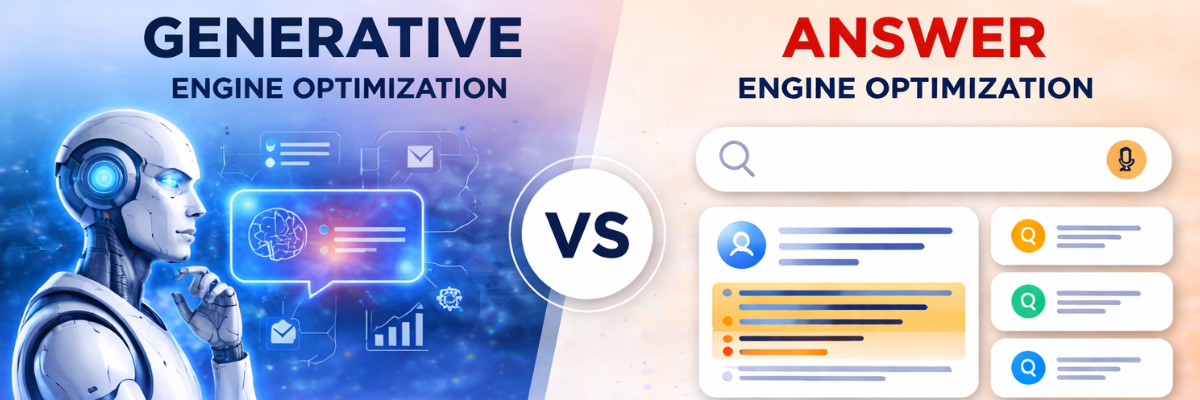
Understanding Generative Engine Optimization (GEO) and Answer Engine Optimization (AEO) starts with the evolution of search. In the early days, search engines were indexers. Users typed short keywords, received a list of links, and manually sifted through results. Visibility depended on ranking and backlinks, but the quality of user engagement was often unpredictable.
Then came Answer Engine Optimization (AEO). Search engines began delivering direct answers—featured snippets, “People Also Ask” boxes, and voice search responses. Users could get what they wanted immediately, and businesses that optimized content for precise questions saw higher visibility and credibility. Now, with Generative Engine Optimization (GEO), AI systems generate answers by combining multiple sources. Your content can influence responses, even if users never click through. This shift means businesses need not just good SEO but trusted, AI-friendly content.
At Digital Marketing Consulting by Dr. Lysetska, we guide you through this evolution with hands-on strategies that ensure your content is optimized for both immediate answers (AEO) and AI-generated responses (GEO), so your business remains visible and authoritative in 2026 and beyond.
What is Answer Engine Optimization (AEO)
AEO focuses on delivering clear, precise answers to user queries. To excel, you need to understand the questions your audience is asking and provide concise, structured responses. For example, if someone asks, “What is digital marketing?”, your content should give a direct answer in the first few sentences, then expand with context and examples. Structured content such as FAQs, headings, and step-by-step instructions increases your chances of being selected for featured snippets and voice search responses.
Why this matters for business growth: appearing in snippets and voice results increases your brand authority, builds trust, and draws qualified leads. With expert guidance from Dr. Lysetska’s consulting team, you’ll learn exactly how to structure your content to capture these opportunities, turning search visibility into measurable business growth.
What is Generative Engine Optimization (GEO)
GEO is deeper and more strategic. AI systems evaluate content to decide which sources to trust and use when generating answers. Unlike AEO, success in GEO does not rely solely on clicks—it relies on authority, clarity, and depth. For GEO, content must:
- Cover topics comprehensively
- Provide precise definitions and context
- Include real-world insights, case studies, and original ideas
- Be structured so AI systems can extract and recombine it easily
This positions your business as a go-to authority, ensuring that AI systems reference your insights even without a direct click.
At Digital Marketing Consulting by Dr. Lysetska, we help businesses build topic authority and AI-friendly content. Our team will show you how to produce high-value, structured content that both humans and AI systems trust, turning your expertise into a sustainable growth engine.
How to Succeed in Answer Engine Optimization (AEO)
To succeed in Answer Engine Optimization, you need to shift your mindset from writing “content” to delivering immediate clarity. The goal is not to impress the reader with depth right away, but to remove friction between the question and the answer.
Step 1: Start with Real User Questions
Every effective AEO strategy begins with understanding how people actually ask questions. Modern search behavior is highly conversational, especially with the rise of mobile and voice search. Users are no longer typing fragmented keywords—they are asking complete, natural-language questions.This means your content should be built around queries such as:
· “What is…”
· “How does…”
· “Why is…”
But more importantly, these questions should reflect real intent. The best approach is to think in terms of problems and needs, not just keywords. What is the user trying to understand, decide, or achieve? When your content mirrors real user language, it becomes significantly easier for search engines to match it to queries and extract relevant answers.
Step 2: Answer Immediately and Directly
Once you identify the question, the next step is to answer it as clearly and quickly as possible. This is where many websites fail—they delay the answer in favor of long introductions or background information. In an AEO-driven approach, the first few lines of your content should directly address the query. Imagine that your answer will be shown out of context, as a standalone snippet. Would it still make sense? Would it still be helpful? A strong answer is:
· Concise, but complete
· Written in simple, clear language
· Free of unnecessary filler
Only after providing the direct answer should you expand into deeper explanations or additional context.
Step 3: Structure Content for Extraction
Search engines do not read content linearly—they scan and extract. This means your content needs to be organized in a way that makes individual sections easy to isolate and understand. Each question should ideally be followed by its own clearly defined answer. Headings should reflect the exact query or a close variation of it. Paragraphs should remain focused on a single idea, rather than mixing multiple concepts together. This structure increases the likelihood that your content can be:
· Featured in snippets
· Used in voice responses
· Selected for “People Also Ask” sections
In essence, you are designing your content not just for readers, but for systems that reuse content in fragments.
Step 4: Use Natural, Conversational Language
AEO is closely tied to how people speak, not just how they type. This is especially important for voice search, where queries are longer and more natural. Instead of writing in a formal or overly technical tone, aim for clarity and accessibility. Your content should feel like a direct response to a real person’s question. This does not mean oversimplifying complex topics, but rather explaining them in a way that is easy to understand without sacrificing accuracy. The closer your language aligns with how users phrase their questions, the more likely it is that your content will be recognized as relevant.
Step 5: Expand Without Losing Clarity
After delivering the initial answer, you should expand the topic to provide additional value. This is where you can introduce examples, deeper explanations, or related concepts. However, it is important that this expansion does not dilute the clarity of the original answer. The structure should always remain layered:
· First, the direct answer
· Then, supporting details
· Then, deeper insights
This approach allows your content to serve both quick-answer queries and users who want a more comprehensive understanding.
Step 6: Continuously Refine Based on Search Behavior
AEO is not a one-time optimization—it is an ongoing process. As search behavior evolves, new questions emerge, and existing ones change in phrasing and intent. Regularly reviewing search queries, user interactions, and content performance allows you to refine your answers and improve their relevance. Over time, this creates a content ecosystem where each page becomes a reliable source of answers across multiple related queries.
Dr. Lysetska’s consulting services guide you through every step of this process, helping your business appear in featured snippets, voice search, and other high-value AEO placements to drive leads and sales.
How to Succeed in Generative Engine Optimization (GEO)
While AEO focuses on delivering immediate answers, GEO is about becoming a trusted source of knowledge that AI systems rely on when generating responses. This requires a deeper, more strategic approach to content creation.
Step 1: Build Content Around Topics, Not Keywords
The foundation of GEO is topical authority. Instead of creating isolated pieces of content targeting individual keywords, you should focus on covering entire subject areas comprehensively. This means thinking in terms of themes rather than terms. For example, instead of writing a single article about SEO, you would create a network of content that explores:
· Strategies
· Tools
· Case studies
· Common challenges
· Industry trends
This interconnected structure helps AI systems understand that your website is not just relevant—but authoritative on the subject.
Step 2: Go Deep, Not Just Wide
Depth is one of the most important factors in GEO. AI systems prefer content that demonstrates a thorough understanding of a topic, rather than surface-level explanations. This involves:
· Exploring nuances and complexities
· Addressing different scenarios and use cases
· Anticipating follow-up questions
The goal is to create content that feels complete. When an AI system evaluates your page, it should find enough information to confidently use it as a source.
Step 3: Write with Clarity and Precision
Clarity is essential because AI systems rely on well-defined information. Ambiguous or vague statements are less likely to be used, as they introduce uncertainty. Each concept should be:
· Clearly defined
· Properly explained
· Supported with context where necessary
Precision in language reduces the risk of misinterpretation and increases the usability of your content in generated responses.
Step 4: Structure Content for Reusability
In GEO, your content is often broken down into smaller pieces and recombined with information from other sources. This means each section should be able to stand on its own. A paragraph explaining a concept should be complete enough to be understood independently, without relying heavily on surrounding text. Clear headings, logical flow, and focused sections all contribute to this reusability.
Step 5: Incorporate Original Insights and Experience
One of the strongest signals you can send in GEO is originality. AI systems are more likely to rely on content that offers something beyond generic information. This can include:
· Real-world experience
· Case studies
· Observations from your work
· Unique frameworks or methods
Original insights not only differentiate your content but also increase its perceived value and credibility.
Step 6: Strengthen Trust and Authority Signals
Trust plays a central role in whether your content is used by AI systems. To build trust, your content should:
· Be factually accurate
· Align with widely accepted knowledge
· Demonstrate expertise
Additional signals such as consistent publishing, high-quality backlinks, and clear authorship further reinforce your authority. Over time, this creates a reputation that makes your content more likely to be selected and used.
Step 7: Think in Terms of Influence, Not Just Traffic
Perhaps the most important mindset shift in GEO is moving beyond traffic as the primary goal. Even if users do not click through to your website, your content can still shape their understanding, influence their decisions, and build brand recognition. Success in GEO means that your content becomes part of the knowledge layer that AI systems rely on. It is less about being visited and more about being trusted and integrated.
With Digital Marketing Consulting by Dr. Lysetska, you gain hands-on support for implementing GEO strategies that make your business a trusted source for AI-powered answers, enhancing visibility and credibility across all channels.
Why Integrating AEO and GEO Will Transform Your Business
Individually, AEO and GEO offer powerful ways to increase visibility. Together, they create a comprehensive growth strategy:
- AEO ensures your content is chosen for quick, precise answers
- GEO ensures your content is trusted and reused by AI systems
- Combined, they maximize authority, brand recognition, and lead generation
Businesses that adopt this dual approach will dominate search results, drive qualified traffic, and convert insights into real revenue.
At Digital Marketing Consulting by Dr. Lysetska, we specialize in full-spectrum digital marketing strategies that integrate SEO, AEO, and GEO. We provide personalized consulting and hands-on support to ensure your content strategy not only reaches the right audience but also converts them into customers. The future of search rewards businesses that adapt early and strategically. If you want your business to appear in featured snippets, voice search, and AI-generated answers while building trust and authority in your industry, now is the time to act.
Contact Digital Marketing Consulting by Dr. Lysetska today to schedule your consultation. We will help you:
- Identify the right AEO and GEO opportunities for your business
- Create content that is optimized for AI and search engines
- Build authority that converts visibility into measurable growth
Be one step ahead of your competitors in AI-powered search. BOOK YOUR CONSULTATION now and let Dr. Lysetska guide your business to the forefront of digital marketing success.